Origins & Migration History
━━━━━━━━━━━━━━━━━━━━
Early Origins
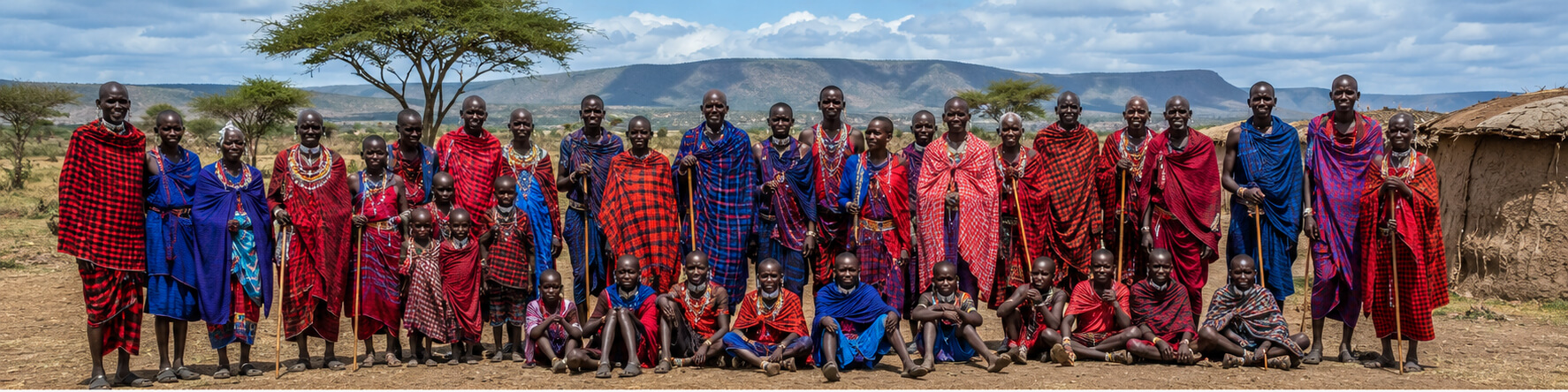
The Maasai are believed to have originated from the lower Nile Valley, north of Lake Turkana (formerly Lake Rudolf) in present-day Sudan and Ethiopia. Oral traditions, corroborated by linguistic and archaeological evidence, describe a gradual southward migration that began as early as the 15th century CE, with the community progressively moving through the Rift Valley corridor and settling across the vast savannahs of East Africa.
The Maa language family — to which Maasai belongs — is part of the Eastern Nilotic branch, shared with the Samburu, Turkana, and other related communities, pointing to a common ancestral heritage rooted in the Great Nile basin.
The Great Migration & Expansion
Between the 17th and 19th centuries, the Maasai expanded dramatically across the Rift Valley, establishing dominance over a vast territory stretching from what is now central Kenya to central Tanzania. At their peak territorial expansion, the Maasai controlled an area exceeding 150,000 square kilometres — a testament to their formidable warrior tradition and sophisticated cattle-based economy.
This era saw the emergence of distinct Maasai sub-groups, including the Purko, Kisongo, Loitai, Matapato, Kaputiei, and others, each occupying specific ecological zones while sharing a common cultural and linguistic identity.
Colonial Period & Modern Era
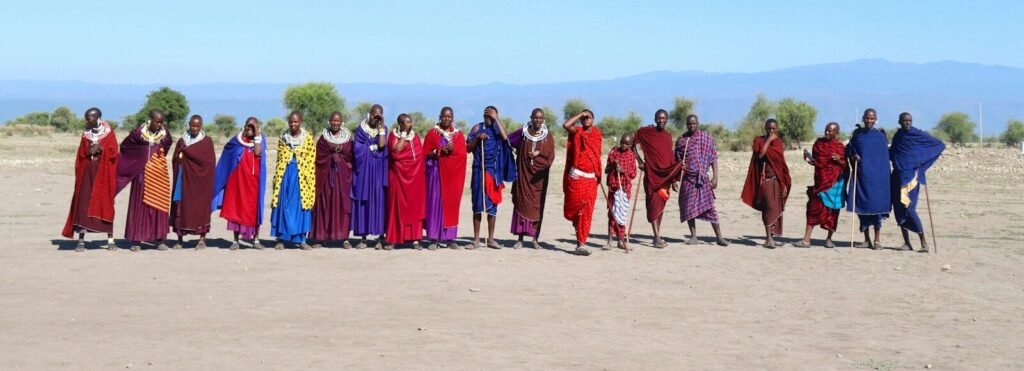
The late 19th and early 20th centuries brought significant disruption through the colonial partition of East Africa, epidemics (including the catastrophic rinderpest epidemic of 1890–1892 that decimated Maasai cattle), and smallpox outbreaks. The Kenya-Tanzania border bisected traditional Maasai grazing lands, creating a geopolitical division that communities navigate to this day through established trans-boundary seasonal migration routes.
Despite these upheavals, the Maasai have demonstrated extraordinary cultural resilience, maintaining their herding traditions, language, spiritual practices, and social structures across generations and into the present day.Language & Oral Traditions
Language & Oral Traditions
The Maa Language
Maa is the mother tongue of the Maasai and one of the most widely spoken Nilotic languages in East Africa. It belongs to the Eastern Nilotic subgroup of the Nilo-Saharan language family. Maa is a tonal language, meaning that the pitch contour of a syllable can change the meaning of a word entirely — a feature that makes it both linguistically complex and extraordinarily expressive.
While Maa does not have a standardized written script with deep historical roots, contemporary efforts by educators, linguists, and cultural organizations have produced written materials, primers, and digital archives to support language preservation. The language remains a primary marker of Maasai identity and is spoken fluently across generations in both rural and peri-urban communities.
Oral Tradition as Living Archive
For the Maasai, oral tradition is not merely a mode of storytelling — it is the primary library of communal knowledge. Passed from elders to youth through formal and informal settings, oral traditions encode history, moral philosophy, ecological knowledge, genealogy, legal norms, and spiritual wisdom.
The principal forms of Maasai oral tradition include:
- Historical Narratives (Enkiama oo Nkiama) — Detailed accounts of significant community events, battles, migrations, and leadership lineages preserved through oral recitation.
- Nkiama (Storytelling) — Narrative tales, often featuring animals as allegorical characters, used to transmit moral values and cultural norms to children and young adults.
- Enkiama (Proverbs) — Concise, wisdom-laden sayings that guide decision-making, mediation, and community relationships.
- Nkiterunoto (Songs) — Songs accompany virtually every life event, from cattle herding and warrior ceremonies to births, marriages, and mourning.
- Enkibenata (Blessings) — Sacred verbal formulae delivered by elders to confer protection, health, and prosperity on individuals and groups.
- Entuata (Riddles) — Used as an educational tool to sharpen the minds of children and transmit knowledge playfully.Featured Proverbs
| “Meeta nabo oltungani nabo oltungani.” — Maasai Proverb |
Translation: “A person is a person because of other people.” This proverb encapsulates the Maasai philosophy of interdependence and communal responsibility — no individual flourishes in isolation from their community.
| “Meitoi enkiama oleng nabo entito naibor.” — Maasai Proverb |
Translation: “Do not speak disparagingly of the white-haired elder.” This proverb reflects the deep veneration of elders and the wisdom accumulated through age and experience.
| “Sidai olong enkata nabo ilkiama.” — Maasai Proverb |
Translation: “Unity is the strength of the age-set.” A recognition that solidarity within the age-set system is the foundation of Maasai social resilience.
Traditional Leadership Structure
The Age-Set System (Ilkiama)
The Maasai social structure is organized around one of the most sophisticated age-set (ilkiama) systems in Africa. Every Maasai male belongs to an age-set — a cohort of men circumcised within the same approximate period, typically spanning seven to fifteen years. These age-sets progress through distinct life stages together, each stage carrying defined roles, privileges, and responsibilities.
The principal age-set stages for men are:
- Ilayiok (Uncircumcised Boys) — Young males before initiation, responsible for herding calves and learning community customs under the guidance of elders.
- Ilmoran (Junior Warriors) — Following circumcision, young men enter the warrior stage. The Ilmoran are the community’s defenders, responsible for protecting livestock, settlements, and territorial boundaries. This phase is marked by distinctive long ochre-dyed hair, elaborate beadwork, and communal warrior camps (emanyatta).
- Iltasaru (Senior Warriors) — A transitional stage preceding elderhood, during which warriors gradually assume greater community responsibilities.
- Ilkiama (Junior Elders) — Upon marriage and the birth of children, men transition to junior elderhood. They begin participating in community governance and dispute resolution forums.
- Ilchamus / Ilkiama Kitok (Senior Elders) — The highest social authority. Senior elders oversee major community decisions, ritual practice, resource management, and the adjudication of disputes. Their counsel is considered binding.
- Iltasat (Elder Elders / Patriarchs) — The most senior category, revered as repositories of the deepest historical and spiritual knowledge.
Women’s Leadership & Social Roles
Maasai women play indispensable roles in community governance, though traditionally within distinct social domains. Women’s councils (enkiama entito) convene to address matters relating to family welfare, marriage, children’s affairs, and the management of homestead resources. Senior women hold significant authority in domestic governance and serve as guardians of ceremonial knowledge, particularly as it relates to birth, naming, and female coming-of-age practices.
In recent decades, Maasai women have increasingly assumed roles in formal governance, environmental conservation leadership, and civil society — contributing powerfully to the community’s adaptation to contemporary challenges.
The Council of Elders (Enkiama)
The Council of Elders is the supreme governance institution of the Maasai community. Convening at the shade of a sacred tree (oltepesi — the African wild fig) or at a central community gathering point, the council deliberates on matters of land use, conflict resolution, ceremonial scheduling, and community welfare. Decisions are reached through consensus, with all voices — particularly the most senior — given careful consideration. The enkiama system has been internationally recognized as a model of indigenous conflict resolution and restorative justice.Traditional Attire & Adornment
Traditional Attire & Adornment
The Significance of Dress
Maasai dress is among the most visually distinctive and symbolically rich in the world. Clothing, jewellery, and body adornment are not merely aesthetic choices — they are precise communicators of identity, social status, age, and life stage. Through careful observation of attire, a knowledgeable Maasai community member can identify another person’s age-set, marital status, lineage, and even geographical origin.
Men’s Attire
Men’s dress varies significantly across age-set stages:
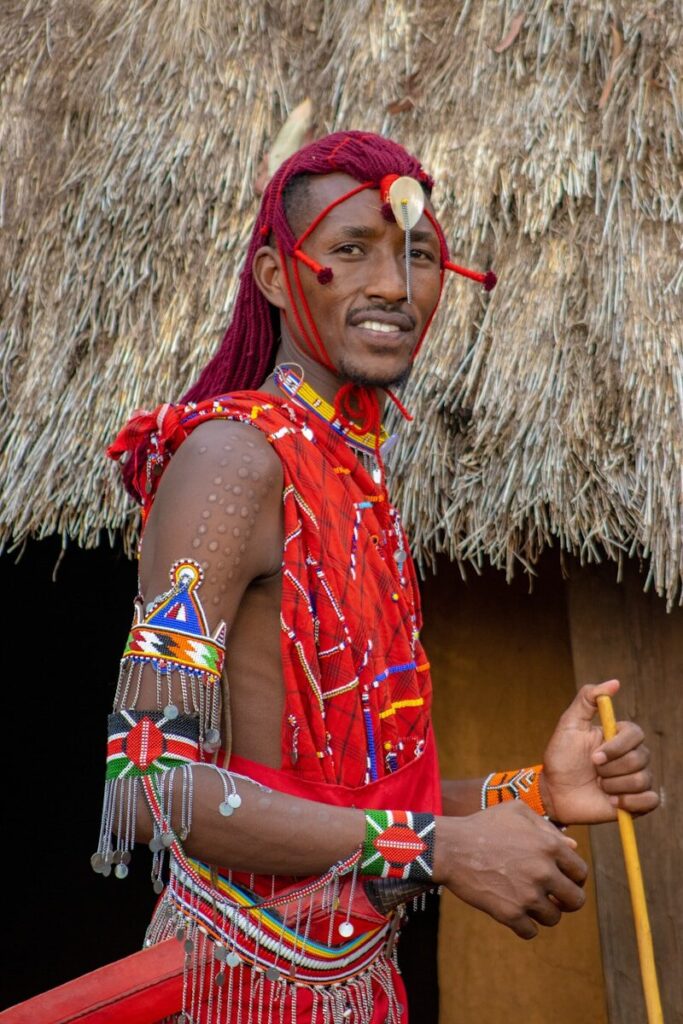
- Shuka (Outer Cloth) — The iconic rectangular cloth worn draped over the body. Red is the dominant colour, symbolising bravery, strength, and the blood of warriors. Blue denotes the sky and water. Black represents hardship. Checks and stripes are also common. The cloth is traditionally tied at the shoulder, leaving one arm free.
- Ilkiloriti (Sandals) — Handcrafted leather sandals, historically made from cattle hide and more recently from recycled vehicle tyres. Their durability is suited to the demanding terrain of Maasailand.
- Orinka (Spear) — Carried by warriors as both a practical tool and a symbol of manhood and protection. The spear is crafted by specialist Maasai blacksmiths (Il-Kunono) and may be personalized with decorative features.
- Rungu (Club) — A short throwing club made from hardwood, carried by elders and warriors. It is a symbol of authority and is also used in traditional competitive games.
- Beaded Accessories — Warriors and young men adorn themselves with elaborate bead collars, wristbands, and ear ornaments. The warrior’s hairstyle — long, thin braids dyed with ochre — is an iconic visual marker of the Ilmoran stage.
Women’s Attire & Jewellery
Maasai women are globally celebrated as master beadworkers, and their adornment is an art form of extraordinary sophistication:
- Enkiishon (Beaded Collar Necklaces) — Married women wear stacked flat disc-shaped beaded collars that can span from the collarbone to the chin. The number and composition of collars signal marital status and the number of children.
- Earrings & Ear Stretching — Large beaded earrings and stretched earlobes are traditional markers of beauty and maturity. The earlobe is stretched progressively using weighted objects from a young age.
- Bracelets & Anklets — Elaborate beaded or wire bracelets are worn on the wrists and ankles, gifted by suitors, family members, or crafted personally.
- Shaved Head — After marriage, women traditionally shave their heads as a mark of new status.
- Kangas and Wraps — Brightly coloured cloth wraps (often in bold geometric patterns) are draped over the body, sometimes complemented by a beaded waistband.
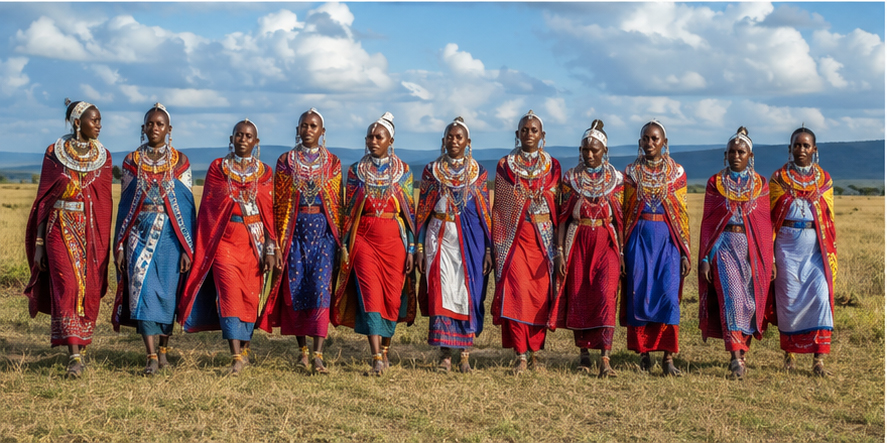
The Language of Colour in Beadwork
The colour symbolism embedded in Maasai beadwork is a sophisticated visual language. While meanings can vary between sub-groups and regions, broadly accepted interpretations include: Red (EnkiJewa) — bravery, blood, unity; White (Naiborr) — purity, health, peace; Blue (Enkare) — sky, water, energy; Green (Narok) — land, sustenance, growth; Orange (Nkijap) — warmth, friendship, hospitality; Yellow (Engito) — fertility, growth, sun; Black (Olodo) — hardship, endurance, solidarity through difficulty.Traditional Food & Cuisine
Traditional Food & Cuisine
The Cultural Role of Food
Food among the Maasai is intimately connected to their pastoral lifestyle and worldview. The community’s relationship with cattle is not merely economic — it is spiritual and philosophical. Cattle (inkishu) are regarded as a gift from Enkai (God) to the Maasai people, and the utilization of cattle products — milk, blood, and meat — reflects a profound reverence for this relationship.
Dietary Foundations
- Maziwa Lala / Kule Naoto (Fermented Milk) — The foundational food of the Maasai diet. Fresh milk is stored in hand-carved gourds (calabashes, enkitura) treated with charcoal, and allowed to ferment naturally. The resulting soured milk is rich in probiotics and has a distinctive, pleasantly tangy flavour. It is consumed daily by all age groups and is offered as a gesture of welcome to visitors.
- Nyama (Meat) — Consumed primarily on ceremonial occasions, during illness, and by warriors during special periods. Beef, goat, and mutton are the most common. Meat is typically roasted over open fire or prepared in a broth with medicinal herbs. Meat and milk are traditionally not consumed in the same meal, reflecting deep dietary customs.
- Osaroi (Blood) — The drinking of fresh cattle blood, often mixed with milk or fermented milk, is a traditional ceremonial practice. Blood is extracted humanely from a live ox via a small incision in the jugular vein, which is sealed afterwards. It is served to warriors during initiation, to new mothers after childbirth, and to those recovering from illness, as it is considered highly nutritious.
- Enkiama (Herbal Broths & Soups) — Elders and those in need of medicinal support consume rich soups made with specific indigenous tree barks, roots, and herbs, known to support immune function, joint health, and recovery from illness. The preparation of these broths is a specialized knowledge held by senior elders and traditional healers.
- Honey (Osotua) — Harvested from wild beehives in the savannah, honey is consumed directly and is also used in the preparation of a traditional ceremonial mead-like beverage.
- Grain & Vegetables — While historically the Maasai diet was predominantly milk-based, contact with neighbouring agricultural communities has introduced maize (ugali), beans, and vegetables as supplementary foods, particularly in peri-urban and semi-agricultural zones.
Food & Ceremony
Specific foods carry ceremonial significance. A bull is slaughtered at major occasions — warrior graduation, elderhood ceremonies, and funerals. The distribution of different cuts of meat follows strict protocol based on age, gender, and social standing, reflecting the community’s hierarchical yet equitable value system.Music, Dance & Performance
Music, Dance & Performance
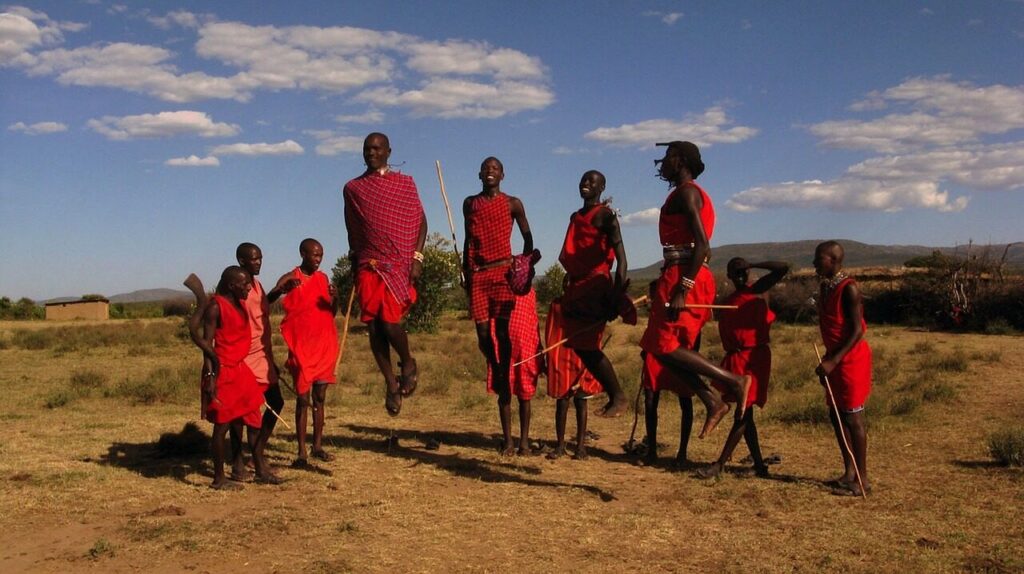
Music as Community
Music permeates every dimension of Maasai life. It accompanies herding and daily work, punctuates ceremonies and celebrations, communicates history and moral instruction, and serves as a medium for courtship. Maasai music is characterized by its use of the human voice as the primary instrument — choral and call-and-response singing, complex polyphonic harmonies, and the remarkable art of throat singing (olaranyani) make Maasai musical tradition one of the most distinctive in Africa.
Traditional Instruments
- Oreteti (Flute) — A simple end-blown flute carved from wood or reed, traditionally played by uncircumcised boys while herding cattle. Its plaintive, melodic sound carries across the open savannah.
- Ilkibolosio (Cowbells) — Cattle bells attached to the necks of prized animals serve a musical as well as practical function, creating a constant ambient soundscape across Maasai grazing areas.
- Enkidong (Gourd Rattle) — A dried gourd filled with seeds or pebbles, used in women’s ceremonial songs and healing rituals.
- Olpiroi (Horn) — A cow or kudu horn blown as a signalling instrument to convene community members, announce ceremonies, or alert to danger.
- Voice & Polyphonic Choral Tradition — The human voice is the supreme Maasai instrument. The olaranyani (lead singer) improvises verses while the choir (il-koriata) responds with rhythmic bass undertones — a tradition structurally similar to certain East African Griot traditions.
Traditional Dances
Nkiama oo Ilchamus (Elders’ Songs) — Senior elders perform deep-voiced ceremonial chants during rituals, blessing ceremonies, and important community gatherings. These songs carry the gravitas of accumulated wisdom and are considered semi-sacred.
Adumu (The Jumping Dance) — The internationally iconic Maasai warrior dance. Young Ilmoran warriors form a circle or semicircle; one or two at a time step into the centre and jump as high as possible, with the body held rigid and arms at the sides. The height of the jump, maintained across repeated efforts, is a display of physical excellence and warrior vitality. The accompanying chant rises in pitch and intensity as the jumping continues. The Adumu is performed at celebrations, including the Eunoto warrior graduation ceremony.
Enkiama oo Nkiri (Women’s Songs & Dances) — Women perform elaborate communal singing dances at weddings, naming ceremonies, and warriors’ graduations. Their voices create complex layered harmonies, and the dance itself involves rhythmic movement of the head and beaded collars in synchrony with the vocal rhythms.
Esoto — A special dance performed at the circumcision period by uncircumcised boys, celebrating the approach of initiation.Ceremonies & Rites of Passage
Ceremonies & Rites of Passage
The Significance of Ceremony
For the Maasai, ceremonies (inkiama) are not mere celebrations — they are the formal mechanisms through which individuals are recognized, transitions are sanctioned, and the community’s relationship with the divine is renewed. Each ceremony is governed by detailed protocols regarding timing, participants, ritual foods, prayers, songs, and the roles of elders, warriors, and women.
Birth Ceremonies (Enkiputata)
The birth of a child is celebrated as a profound blessing from Enkai. In the days following birth, the mother and child are confined to the enkiaji (homestead) in a period of protection and recovery. On the third day for a girl and the fourth day for a boy (reflecting numerical gender symbolism), senior women and close family gather to perform prayers and blessings over the newborn. The child is anointed with fat, and a senior woman spits on the child’s head as a formal blessing (a gesture that carries deep spiritual significance among the Maasai).
Naming Ceremonies (Enkiputata oo Nkarna)
The formal naming of a child typically occurs after the birth ceremonies, once the child has been assessed as healthy and strong. Names are drawn from natural phenomena, livestock, events occurring around the time of birth, or the names of respected ancestors and elders. In many cases, a child will carry multiple names: a personal name, a community name, and a name given by the age-set peers. Naming is performed by elders and accompanied by communal prayers, songs, and a shared meal.
Circumcision & Initiation (Enkiama oo Ilkiama)
Male circumcision (enkiama) is the single most significant rite of passage in Maasai society, transforming a boy (olayiok) into a warrior (olmoran). The circumcision itself is performed by a specialist elder using a traditional knife, and the initiate must demonstrate stoic courage throughout — showing fear or flinching is considered deeply shameful and carries lasting social stigma. The ceremony is preceded by months of preparation: the initiate undergoes the ritual hunting of specific birds (whose feathers adorn his ceremonial regalia), receives instruction from senior warriors, and participates in the esoto dances.
Following circumcision, the initiate enters a healing and transition period during which he wears black clothing, adorns himself with the ceremonial bird feathers, and is cared for by his mother and female relatives. He gradually takes on warrior responsibilities as healing progresses. The formal graduation from junior to senior warrior status is marked by the Eunoto ceremony.
Eunoto — Warrior Graduation Ceremony
The Eunoto is one of the most elaborate and emotionally powerful ceremonies in the Maasai calendar. It marks the formal transition of a group of warriors (an ilkiama age-set) from the junior warrior (ilmoran) stage to senior warrior (iltasaru) status. In a deeply moving ritual, each warrior’s mother shaves his long ochre-dyed hair — the most visible symbol of his warrior identity — for the first time since circumcision. Warriors are anointed with fat and ochre, receive new privileges and responsibilities, and the age-set formally advances as a collective. The ceremony is accompanied by days of feasting, singing, dancing, and communal celebration.
Marriage Ceremonies (Enkiama oo Enkiputata)
Maasai marriages are arranged through family negotiation and the exchange of bride wealth (enkidong) — typically a specified number of cattle, sheep, and goats, the composition of which reflects the bride’s family’s status and the suitor’s ability. The marriage process is extended, involving multiple stages of negotiation, gift exchange, and ceremony. The wedding ceremony itself is a multi-day celebration involving the entire community, with elaborate feasting, music, prayer, and the formal procession of the bride to her new homestead. The bride’s mother and female relatives present her with essential household items, and she receives her own cattle to begin building her personal herd.
Elderhood Ceremonies (Orngesherr)
The Orngesherr ceremony marks the formal transition of senior warriors into junior elderhood (ilkiama). This ceremony is among the most spiritually significant in the Maasai calendar, as it involves the slaughter of an ox and communal feasting, the formal receipt of a new distinctive rungu (elder’s club) that replaces the warrior’s spear as the primary symbol of status, and the assumption of governance responsibilities within the community council. After Orngesherr, a man’s primary role shifts from defence and physical prowess to wisdom, deliberation, and spiritual leadership.
Annual Cultural Celebrations
Beyond individual rites of passage, the Maasai community marks seasonal transitions and collective milestones with communal gatherings. The Olng’esherr (large age-set ceremonies) occur approximately every fifteen years as an entire generation advances through the age-set hierarchy. Seasonal rainfall ceremonies (ilchamus enkiama) are conducted to seek Enkai’s blessing for good rains, abundant pasture, and the health of the cattle and community.Marriage & Family Traditions
Marriage & Family Traditions
Courtship & Partnership
Maasai courtship is a structured, community-sanctioned process that begins in the warrior stage. Young ilmoran warriors are permitted to have social relationships with pre-initiated girls (intoyie), who craft elaborate bead ornaments as gifts for their preferred warriors. These relationships are understood within a defined cultural framework and are generally supervised by community norms.
Marriage as Community Bond
Marriage in Maasai society is understood not merely as a union between two individuals, but as a formal alliance between two family lineages. The negotiations (enkiputata) are conducted by elders and senior family members on both sides, with great care taken to ensure compatibility of clan lineage (marriage within the same clan is prohibited), social standing, and the appropriate composition of bride wealth. This careful negotiation process reflects the Maasai understanding of marriage as a community institution with enduring consequences for all involved.
Family Structure & Homestead Life
The Maasai homestead (enkiaji or manyatta) is the primary social and economic unit. A traditional enkiaji is a circular settlement enclosed by a thorny acacia fence (enkang), within which individual family houses (inkajijik, singular enkaji) are arranged. Each wife in a polygynous household manages her own house, cookfire, and cattle pen. Children are the responsibility of the entire homestead, and the communal raising of children ensures deep bonds of solidarity across the extended family network.
Child Naming & Identity
Children receive their names through a multi-layered naming tradition. Personal names often reflect the circumstances of birth — the time of day, the weather, an event occurring at the time, or an aspiration held by the family. Every child is also formally incorporated into the father’s age-set lineage and the broader clan structure, receiving a social identity that connects them to the full web of Maasai community relationships.Indigenous Knowledge Systems
Indigenous Knowledge Systems
A Philosophy of Ecological Stewardship
The Maasai have developed, over centuries of inhabiting the East African savannah, one of the world’s most sophisticated systems of indigenous ecological knowledge. Their understanding of landscape, weather patterns, animal behaviour, plant medicine, and seasonal dynamics reflects millennia of careful observation, experimentation, and oral documentation — a body of knowledge now recognized by conservation scientists and ethnobotanists as carrying immense scientific value.
Livestock Management
Maasai pastoralism is far more complex than simple herding. The community maintains sophisticated knowledge of cattle breeds, animal health, genetic selection, and seasonal grazing management. The traditional practice of communal land tenure (enkiama oo eland) ensures that grazing areas are rotated systematically to allow grassland recovery — a principle that modern range management science has validated. Maasai herders are trained from childhood to read the condition of grazing land, identify early signs of drought stress, and make strategic decisions about herd movement.
Traditional Veterinary Medicine
A rich pharmacopoeia of plant-based treatments for common livestock diseases has been developed and refined by Maasai pastoralists over generations. Senior elders and specialist healers (iloibonok) maintain knowledge of specific tree barks, roots, leaves, and minerals used to treat respiratory infections, skin conditions, reproductive disorders, and nutritional deficiencies in cattle. This knowledge system, passed orally through apprenticeship, represents an irreplaceable database of ethnopharmacological information.
Human Herbal Medicine
The Maasai human medicinal pharmacopoeia includes over a hundred plant species used for therapeutic purposes. Significant medicinal plants include the Oreteti (Acacia tortilis) used in treatments for respiratory conditions; the Olaranyani (Olea africana) whose bark is used in fever management; and various species of Aloe, used for wound healing and skin conditions. The Oloibon (plural: iloibonok) — the Maasai spiritual healer and diviner — serves as both physician and spiritual counsellor, drawing on herbal knowledge and ritual practice to address physical and psychological illness.
Weather Prediction & Environmental Reading
Maasai elders maintain detailed traditional knowledge for predicting rainfall patterns, identifying drought indicators, and reading environmental signals. The flowering of specific plant species, the behaviour of particular bird and insect species, the direction of prevailing winds, and the appearance of the night sky are all read as indicators of forthcoming weather. This knowledge directly informs the timing of seasonal herd movements and agricultural decisions.
Conflict Resolution
The Maasai legal tradition (enkiama oo nkisoroi) is a sophisticated system of customary law administered by the Council of Elders. Disputes over land, cattle, water rights, marriage, and interpersonal conflict are resolved through structured deliberative processes that prioritize restoration of community harmony over punitive outcomes. The system employs trained elder mediators, formal hearing procedures, and agreed compensatory mechanisms. It has been studied extensively by legal anthropologists and applied conflict resolution practitioners as a model of indigenous restorative justice.Sacred Sites & Cultural Landscapes
Sacred Sites & Cultural Landscapes
The Spiritual Landscape of Maasailand
For the Maasai, the landscape itself is sacred. The land is not merely a resource to be managed — it is the physical manifestation of the relationship between Enkai (God) and the Maasai people. Specific geographical features hold deep spiritual and historical significance, serving as sites of prayer, ceremony, ancestral memory, and communal identity.
Key Sacred & Cultural Locations
Enkiama Ceremonial Grounds — Throughout Maasailand, designated open areas (often in the shade of large fig or acacia trees) serve as the formal gathering grounds for councils, ceremonies, and community assemblies.
Ol Doinyo Lengai (Mountain of God) — An active volcano in northern Tanzania, Ol Doinyo Lengai is the most sacred mountain in Maasai cosmology. It is considered the dwelling place of Enkai and is a site of pilgrimage, prayer, and deep spiritual reverence. Eruptions of the volcano are interpreted as manifestations of divine communication.
Ngong Hills (Maasai: Enkong’u e Naiposha) — The rolling Ngong Hills south of Nairobi hold historical significance as a traditional Maasai gathering, grazing, and ceremonial area. Their distinctive silhouette is a symbol deeply embedded in Maasai cultural consciousness.
Amboseli Basin & Kilimanjaro Corridor — The vast plains surrounding Amboseli, within sight of Kilimanjaro, represent a core Maasai ancestral territory, rich in sacred sites, ancestral burial grounds, and traditional governance boundaries.
Loita Hills Forest (Naimina Enkiyio — Forest of the Lost Child) — A cloud forest in the Narok County highlands, held sacred by the Loita Maasai sub-group. It is a site of the rare Ilkiama oo Enkiputata ceremony and is the spiritual heartland of the Loita community. The forest is managed under traditional communal governance and has been at the centre of landmark indigenous land rights advocacy.Arts, Crafts & Creative Expression
Arts, Crafts & Creative Expression
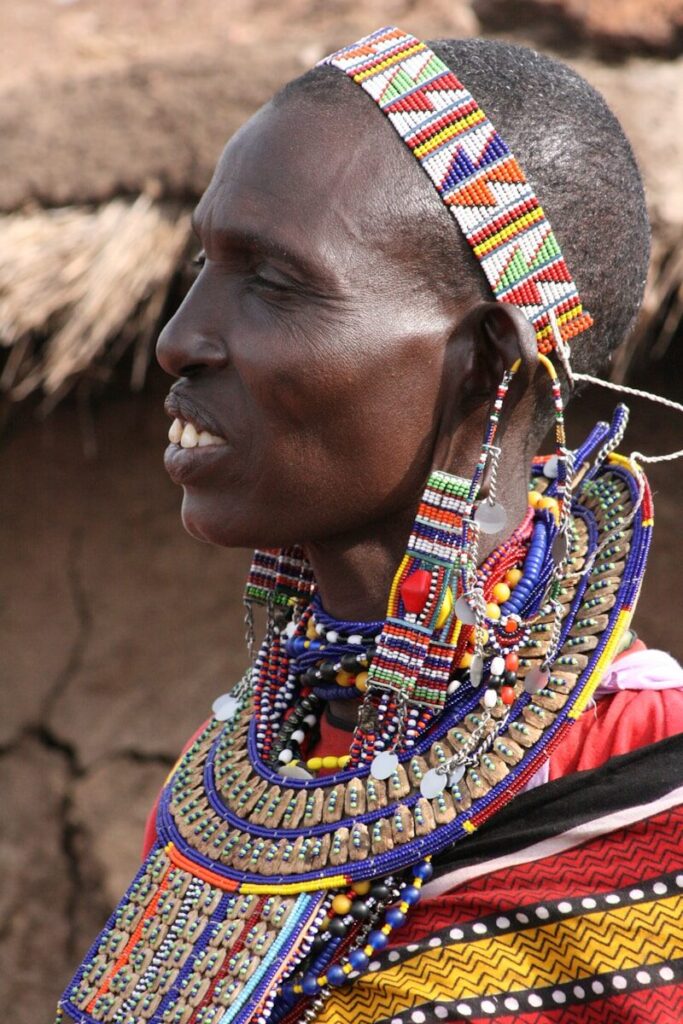
Beadwork — The Art of Identity
Maasai beadwork is recognized internationally as one of the finest and most complex traditions of wearable art in the world. Historically crafted from organic materials — including ostrich eggshells, seeds, and clay — Maasai beadwork transitioned to glass and metal beads through trade from the 19th century onwards. Today’s beadwork continues to serve its ancient function as a medium of identity, status communication, and spiritual expression, even as it has also become a significant element of the global craft and luxury goods market.
Beadwork is primarily the domain of women, who learn the craft from mothers and grandmothers from childhood. Master beadworkers develop highly individualized styles and are recognized community artisans. Specific designs, patterns, and colour combinations can be regionally distinctive — enabling knowledgeable viewers to identify the sub-group and even the general area of origin of a beadworker from her work.
Leather Craft
The working of cattle hide into functional and decorative items — including sandals, bags, belts, ceremonial regalia, and house furnishings — is a traditional craft maintained primarily by Maasai men and specialist craftspeople. Hide is prepared through a traditional tanning process using animal fats and natural mineral compounds, producing durable and supple leather well suited to the demands of pastoral life.
Wood Carving & Functional Art
Maasai wood carvers produce items including the rungu (club), walking sticks, ceremonial staffs, milk gourds and containers, and decorative household items. The quality of carving in traditional items — the balance of a rungu, the elegance of a walking staff — reflects an aesthetic sensibility that values both function and beauty.
Architecture
The traditional Maasai house (enkaji) is a remarkable feat of vernacular architecture, designed by women and constructed collaboratively by female members of the community. Built from a framework of bent sapling branches plastered with a mixture of cattle dung, mud, ash, and urine — a compound that dries to remarkable hardness and insulating efficiency — the enkaji is an ingeniously adapted dwelling for the semi-arid savannah environment. Its low profile reduces exposure to wind, its thick walls moderate interior temperature, and its circular form maximizes structural stability.Notable Maasai Personalities
Notable Maasai Personalities
The Maasai community has produced exceptional individuals whose contributions span governance, conservation, academia, athletics, the arts, and international diplomacy. These personalities carry the Maasai identity onto the world stage while remaining deeply connected to their community roots.
- Ol Lemeki — Historical Maasai laibon (spiritual leader) and warrior commander of the 19th century, known for leading resistance against colonial incursion and for his role in the inter-Maasai alliances of the late 1800s.
- Mereso Kantai — A prominent Maasai rights advocate, writer, and intellectual whose work on Maasai land rights has been internationally recognized.
- Samuel Poghisho — A pioneering Maasai conservation leader instrumental in establishing community conservancies in Maasailand that balance pastoral land use with wildlife conservation.
- Kakenya Ntaiya — An internationally recognized Maasai educator and women’s rights advocate who founded the Kakenya Center for Excellence in Kajiado County, providing quality education to Maasai girls.
- David Rudisha — Olympic gold medallist and world record holder in the 800 metres, representing Kenya internationally. A member of the Maasai community from Kilgoris, Narok County, Rudisha is celebrated both as an athletics legend and as a proud ambassador of Maasai identity on the global stage.
Additional profiles of community leaders, scholars, artists, and cultural ambassadors to be added with community contributions.
The Maasai Community Today
Navigating Modernity
The Maasai community stands at a fascinating and complex intersection of tradition and modernity. While deeply committed to the preservation of core cultural values — the age-set system, ceremonial practice, the Maa language, and their pastoral identity — Maasai communities across Kenya and Tanzania are actively engaging with contemporary opportunities in education, technology, entrepreneurship, conservation, and formal governance.
Education
Access to formal education has expanded significantly across Maasailand in recent decades, driven by government programmes, NGO investment, and the community’s own growing recognition of formal education as a tool for self-advocacy and resource access. Community-led initiatives increasingly seek to integrate Maasai cultural content — including Maa language instruction, traditional knowledge, and cultural values — into formal school curricula, ensuring that education strengthens rather than erodes cultural identity.
Conservation & Environmental Leadership
The Maasai have emerged as pioneering leaders in community-based conservation, establishing a network of community conservancies across Maasailand that have produced some of East Africa’s most successful wildlife recovery stories. The Olare Motorogi, Naboisho, Ol Kinyei, and Mara North conservancies, all operating on Maasai community land, are managed through structures that equitably distribute conservation revenues to landowner families while maintaining viable pastoral land use. This model has attracted global attention as a sustainable approach to human-wildlife coexistence.
Tourism & Cultural Enterprise
Cultural tourism is a significant and growing contributor to Maasai community livelihoods. Maasai-owned and operated tourism enterprises — including eco-lodges, cultural villages, guiding services, and craft markets — generate income that supports community development while creating the conditions for cultural exchange on Maasai terms. Leading examples of Maasai cultural tourism emphasize authenticity, community benefit, and the educational empowerment of visitors.
Youth Leadership & Technology
A dynamic generation of young Maasai leaders is harnessing technology — mobile communications, social media, digital storytelling, and e-commerce — to amplify Maasai voices, document cultural heritage, market traditional crafts to global audiences, and build solidarity networks across the diaspora. Youth-led initiatives are at the forefront of the movement to reclaim the Maasai narrative from external representation and build digital infrastructure for community knowledge preservation.Digital Archive
Digital Archive
The So Tribal Digital Archive is a growing repository of primary cultural materials contributed by Maasai community members, elders, scholars, and cultural practitioners. All materials are held in trust for the Maasai community and are accessible for educational, cultural, and research purposes in accordance with community data sovereignty principles.Contribute to This Encyclopedia
Contribute to This Encyclopedia
This encyclopedia is a living document — a community-owned, community-built resource that grows richer with every contribution. The So Tribal Digital Tribal Encyclopedia is committed to ensuring that the Maasai community is the primary author of its own cultural record.
Are you a member of the Maasai community, a cultural practitioner, an elder, a researcher, or a community ally? We invite you to contribute:
- Personal and family histories — genealogies, migration stories, and ancestral narratives.
- Photographs — historical and contemporary images of community life, ceremonies, landscapes, and individuals (with appropriate permissions).
- Audio recordings — proverbs, songs, elder interviews, oral histories, blessings, and language recordings.
- Video footage — ceremony documentation, cultural demonstrations, dance performances, and community conversations.
- Historical documents — letters, community records, colonial-era materials, maps, and written accounts.
- Traditional knowledge contributions — recipes, medicinal plant knowledge, ecological knowledge, and craft traditions.
- Artisan profiles and craft documentation — beadwork designs, carving traditions, and leather craft techniques.
All contributions are reviewed by the So Tribal editorial and community advisory team prior to publication. Contributors retain attribution and are acknowledged in the encyclopedia record. Community data sovereignty principles govern all material held in the archive.
“Preserving Heritage. Celebrating Identity. Connecting Communities.”
So Tribal Digital Tribal Encyclopedia
© So Tribal All rights reserved. Content held in trust for the Maasai community.